Some 25 years ago, I was reading Phil Rosenthal, then the TV columnist for the Los Angeles Herald-Examiner. He mentioned catching “Living it Up” (1954) on TV over the weekend, and was puzzled as to how Dean Martin and Jerry Lewis could have been so fantastically popular during the 1950’s. I could relate, thinking back to my teen years when I'd watched “Jumping Jacks” (1952) one weekday afternoon and made the same observation.
My mother set me straight: “You never got to see them on The Colgate Comedy Hour. It was a live variety show and they were hysterically funny on it.” Ignorant of such things as kinescopes, I assumed I would never have that pleasure. Leonard Maltin could only write about their films in his book “Movie Comedy Teams” (1970, in which he labeled “Living it Up,” “probably their best”), with The Colgate Comedy Hour limited to a paragraph not much more detailed than my mom’s recollection. As late as 1985, when Rosenthal dismissed them, the only Martin & Lewis to be had were their 16 theatrical features. Today, of course, it’s a different story: the Colgates are ubiquitous on bargain-basement DVDs and as accessible as a YouTube search.
As I've written elsewhere, what made Martin & Lewis so dazzling, so captivating, is that each man made the other look positively brilliant. To discover their TV and, to a lesser extent, radio shows from the early fifties is to behold two guys in love with each other and their work, and having the time of their lives. Dean and Jerry created a symphony of slapstick that left audiences helpless with laughter – yet no matter how mad the hijinks, there was an undercurrent of mutual affection that won them a fulsome adoration other teams would never know. The two were the very definition of what we now term a bromance (although a few 1950's scandal sheets alleged the relationship veered into the forbidden zone). Watching the Colgates, you marvel at how often they keep touching each other. Laurel & Hardy, bedded down together for the night, didn't come into as much intimate contact as these two did just standing in front of the orchestra. And America adored it all; at their height, Martin & Lewis were the highest paid, most successful act in show business. The Smoothie from Steubenville and the Nebbish from Newark transcended any stage, screen or TV star you'd care to name.
 Three generations have come along since Martin & Lewis went their separate ways. While a vociferous contingent of Dino fans would be horrified if their epitome of cool and suave had never parted from the screechy "Hey, La-a-a-d-y-y" guy, at the time it seemed unthinkable. The nation so loved Dean and Jerry that, even though they worked solo for 35 years, neither would ever be permitted to forget the other. During their first twenty years apart, when mutual animosity was at full strength, nothing brought a crowd to life faster than when one would mention his ex-partner.
So how and why did this partnership, seemingly beloved on all sides, self-destruct? It's a question that has spurred interest for over a half-century. Even Lewis' heartfelt account of the team, "Dean & Me: A Love Story," doesn't tell the whole story. With this entry, we'll look at the first full-blown argument between Dean and Jerry, which took place 56 years ago this month.
As late as 1952, both men were assuring Louella Parsons' readers that they'd never so much as raised their voices to one another. But apparently things had changed a short year later. Tension had been brewing between the two for several months, and by early '54, it spilled out into the open.
To begin with, when "That's Amore" became Dean's first big smash near the end of 1953, it created a strain. Martin was justifiably proud of his accomplishment; it was something for which he'd been striving since before the team was born. Unfortunately, the insecurity within Lewis's psyche that had remained relatively under control during the glory years began to flare. Maybe Dean would decide that he didn't need Jerry anymore. Maybe Dean was beginning to listen to those hangers-on who enjoyed telling each one that he'd be an even bigger star without the other. This time, rather than talk out his feelings, Lewis began to brood - and to assert his presence in their act.
Near the start of the Colgate hour of January 10, 1954, Jerry presented Dean with a gold record for "That's Amore" with his warm congratulations. The conclusion of the show was something else again. The pair staged what appeared to be a mock argument, at which point Martin ordered his partner off the stage. Dean began singing "Amore," but Jerry returned, bribing the cameramen to move in and force Dean into a corner, whereupon Jerry climbed upon the singer's back, smacked Dean's ears and pulled his hair while laughing manically. Dean tried to take it in stride, at one point calling out, "You're over-acting, Jerry," which was something of a code phrase used when one or the other was getting too rough. This time, Lewis didn't let up, and it's clear just before the fade-out that Martin was genuinely steamed.
In truth, Dean was growing weary of Jerry’s antics overshadowing the act, not to mention their hectic schedule, which left him little time to enjoy the fruits of success. He also couldn’t have been pleased when, in a fit of pique, Lewis dismissed their head writers, Ed Simmons and Norman Lear, shortly before the January 10 show; these were the guys who made sure he was funny, too. Additionally, Martin didn't understand Lewis' overt desire to bring pathos into their act, telling him, "Why don't you cut out this sad stuff and just be funny?" But his real bone of contention was their movies, the one element of their work destined for posterity. To the end of his days, Martin resented that most were cut from the same cloth: Jerry the innocent simpleton hero who carried the picture, and Dean the smooth sharpie who never seemed deserving of his partner's friendship, until the final reel when he suddenly became, in his words, "a right guy."
Upon conclusion of the Colgate segment, the team went to New York for a two-week stint at th e Copacabana. On opening night, Hal Wallis and his partner Joe Hazen, along with their wives, enjoyed the performance from a ringside table. After the show, Wallis and Hazen met briefly with the team, setting up a luncheon meeting for the following day to discuss their next picture: "Big Top." The film had been in the planning stages for several weeks; the script written by Don McGuire, a friend and collaborator of Jerry’s since 1951.
When Wallis asked Martin if he’d be attending, Lewis kiddingly advised his partner: "You’d better let me go with him alone. I can get more out of him." Given his growing disenchantment with the status quo, perhaps that should have thrown up a red flag for Dino. Up to now, Martin had grudgingly accepted their scripts as the nature of the business, believing neither he nor Lewis were in a position to tempt the fate of the box office. But with a friend of Jerry’s as the lead writer, and with Jerry himself overseeing the results, perhaps he could expect something better this time. So Dean left the business to Jerry, who went over the script with Wallis and made several suggestions... for his own character.
On February 8, the scheduled first day of shooting, Wallis had the Clyde Beatty Circus, a fifteen-car train and eighty-five cast and crew members standing by on location in Phoenix, Arizona. All that was missing were the two stars, who refused to show up. The team’s agent, Herman Citron, told Wallis bluntly that Dean refused to do the script as written – this despite the fact that it contained several of Jerry’s suggestions - and Jerry wouldn’t do the film against Dean’s wishes.
McGuire and the team’s Colgate writers, Arthur Phillips and Harry Crane, sat down and hammered out further revisions, while Martin, Lewis and Citron met with Wallis. Lewis confessed, "I am enough of a ham that when you told me this business with the elephants and the other sequences, that I could only see what wonderful things I could do..." to the point where he completely overlooked his partner’s role, the conniving, slimy manager of the circus. It’s not recorded whether Dean opined on how well his partner was looking out for him, but he did make his objections known about the script. Wallis later wrote, "He said that he doesn’t want to play a cheat and doesn’t know what he is doing in the picture." The story had Dean singing only two songs: one to caged animals, the other to Jerry.
 Lewis, Phillips and Crane spent one more long night penning revisions, with Martin once again deferring to his partner. The end result wasn’t much different, and Dean realized that it was endgame: with Jerry and their writers having turned in a final script, he’d have to go to work. But that didn’t mean he’d have to like it.
Shooting for the film, eventually titled "Three-Ring Circus," began in Phoenix on February 17. Two weeks went by before Martin was even needed for a scene, at which point some of the extras began wondering aloud about the size of his part and if he was still Jerry’s partner. (Note the attached page from TV and Movie Screen, a fan mag: a large shot of Lewis in character, a small inset of Martin waiting between takes.) Young children hired for an orphanage scene would gather around Jerry; some of them didn’t even know who Dean was. Lewis would later write, "It got pretty hairy. There were days when I thought Dean would ditch the whole package."
On March 3, Dean walked in on Jerry having his picture taken and being interviewed... alone. The easy-going Italian finally boiled over: "Hey, Jerry, what am I around here, a fifth wheel? If I’m not important to the act anymore, just let me know!" Reporters around the set got more from Martin: "I’m sick and tired of playing stooge to that crazy, mixed-up character!" Lewis retaliated with, "I’m fed up with my partner’s sensitivity. Everything I do is wrong. Anything happens he don’t (sic) like, he blames it on me. He hates me." The two stopped speaking and production nearly ground to a halt.
This particular feud, the first to be reported, lasted nine days. On March 12, in a meeting at MCA, the pair were forcibly reminded of their various commitments and coerced into a cordial reconciliation. But four days later, when Dean didn’t appear at Jerry’s birthday party – because he hadn’t been invited – the gossip columns again speculated on Martin and Lewis’s rapidly diminishing future together. The two issued a press release on the 18th, in which Lewis stated, "We had a disagreement. Well, it wasn’t exactly a disagreement, it was a fight. It started when Dean called me a dope. I got mad and told him to prove it, and that’s what we fought about. He did." Martin asserted that the team would split "on July 25, 1996 – our Golden Anniversary."
 Needless to say, this lighthearted approach didn't keep reporters at bay, to the point where, on April 5, no less an authority than Groucho Marx felt compelled to write: "I've been reading in columns that there is ill feeling between you boys and that there's even a likelihood that you might go your separate ways. I hope this isn't true for you are awfully good together, and show business needs you.... If there is any ill feeling or bitterness between you, it will eventually affect your work. If that feeling does exist, sit down calmly together, alone - when I say alone, I mean no agents, no family, no one but you two - sit down alone, and talk it out."
Reportedly Marx sent the letter to both partners, but only Jerry replied, thanking Groucho profusely, noting "the sagacity of your words" and assuring him, "(I) have every intention of following your advice." And in fact Dean and Jerry did meet privately shortly thereafter, and things settled down.
Near the conclusion of shooting for "Three-Ring Circus," the two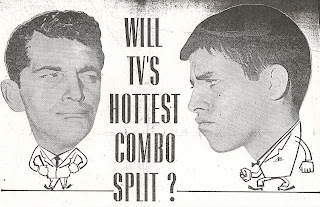 men spoke with Maurice Zolotow, Hollywood correspondent for The American Weekly, a Sunday newspaper supplement. Dean instructed Zolotow to "write down this part word-for-word just like I say it. I know that individually, going it alone, we would not be as great as we are together." Martin added, "When we shook hands on our partnership, I said in my heart, this is forever, ‘til death do us part. It still goes! Sometimes he makes mistakes. Sometimes I make mistakes. But as long as people let us alone, the team of Martin & Lewis will go on."
 For his part, Lewis told Zolotow, "The closer you are to a person, the deeper the feelings. If the feelings are hard feelings, then they’re twice as hard. And if you’re emotional, like Dean and I are emotional, well, you can’t help flipping your lid sometimes. We yell at each other… and it gets in the papers. So from this they build up a story that we’re going to bust up. Never in a million years! Get this: we’re a partnership, a real partnership.
"This idea that I’m the funny guy and Dean is just a straight man is wrong. People may not notice it, but he’s got as many joke lines as straight lines. I feed him as many straight lines on our television show as he feeds me. Both of us have a different style of playing comedy, but we’re both essential to each other’s success. Anyway," continued Lewis, "Dino means more to me than a partner in a two-act. Outside of my wonderful wife, Dean is the person I’ve been closest to in my whole life. We’re so close that our minds think like one mind. There’s a very deep and profound love between Dean and me, and our act is good only because of this feeling of closeness."
A bullet had been dodged and the partnership was again on an even keel, so far as the public knew. Their next Colgate appearance, on May 3, attempted to seal it via a celebration of the team's eighth anniversary, with a highly fictionalized depiction of how the two paired up that concluded with them singing a ditty entitled "We Belong Together." But intimates knew that nothing much had changed: Lewis still controlled the act, which saw more and more "sad stuff" for Jerry, while Dean's part in their next picture, "You're Never Too Young," was no improvement over "Three Ring Circus." Another confrontation was inevitable.
My mother set me straight: “You never got to see them on The Colgate Comedy Hour. It was a live variety show and they were hysterically funny on it.” Ignorant of such things as kinescopes, I assumed I would never have that pleasure. Leonard Maltin could only write about their films
 in his book “Movie Comedy Teams” (1970, in which he labeled “Living it Up,” “probably their best”), with The Colgate Comedy Hour limited to a paragraph not much more detailed than my mom’s recollection. As late as 1985, when Rosenthal dismissed them, the only Martin & Lewis to be had were their 16 theatrical features. Today, of course, it’s a different story: the Colgates are ubiquitous on bargain-basement DVDs and as accessible as a YouTube search.
As I've written elsewhere, what made Martin & Lewis so dazzling, so captivating, is that each man made the other look positively brilliant. To discover their TV and, to a lesser extent, radio shows from the early fifties is to behold two guys in love with each other and their work, and having the time of their lives. Dean and Jerry created a symphony of slapstick that left audiences helpless with laughter – yet no matter how mad the hijinks, there was an undercurrent of mutual affection that won them a fulsome adoration other teams would never know. The two were the very definition of what we now term a bromance (although a few 1950's scandal sheets alleged the relationship veered into the forbidden zone). Watching the Colgates, you marvel at how often they keep touching each other. Laurel & Hardy, bedded down together for the night, didn't come into as much intimate contact as these two did just standing in front of the orchestra. And America adored it all; at their height, Martin & Lewis were the highest paid, most successful act in show business. The Smoothie from Steubenville and the Nebbish from Newark transcended any stage, screen or TV star you'd care to name.
 Three generations have come along since Martin & Lewis went their separate ways. While a vociferous contingent of Dino fans would be horrified if their epitome of cool and suave had never parted from the screechy "Hey, La-a-a-d-y-y" guy, at the time it seemed unthinkable. The nation so loved Dean and Jerry that, even though they worked solo for 35 years, neither would ever be permitted to forget the other. During their first twenty years apart, when mutual animosity was at full strength, nothing brought a crowd to life faster than when one would mention his ex-partner.
So how and why did this partnership, seemingly beloved on all sides, self-destruct? It's a question that has spurred interest for over a half-century. Even Lewis' heartfelt account of the team, "Dean & Me: A Love Story," doesn't tell the whole story. With this entry, we'll look at the first full-blown argument between Dean and Jerry, which took place 56 years ago this month.
As late as 1952, both men were assuring Louella Parsons' readers that they'd never so much as raised their voices to one another. But apparently things had changed a short year later. Tension had been brewing between the two for several months, and by early '54, it spilled out into the open.
To begin with, when "That's Amore" became Dean's first big smash near the end of 1953, it created
 a strain. Martin was justifiably proud of his accomplishment; it was something for which he'd been striving since before the team was born. Unfortunately, the insecurity within Lewis's psyche that had remained relatively under control during the glory years began to flare. Maybe Dean would decide that he didn't need Jerry anymore. Maybe Dean was beginning to listen to those hangers-on who enjoyed telling each one that he'd be an even bigger star without the other. This time, rather than talk out his feelings, Lewis began to brood - and to assert his presence in their act.
Near the start of the Colgate hour of January 10, 1954, Jerry presented Dean with a gold record for "That's Amore" with his warm congratulations. The conclusion of the show was something else again. The pair staged what appeared to be a mock argument, at which point Martin ordered his partner off the stage. Dean began singing "Amore," but Jerry returned, bribing the cameramen to move in and force Dean into a corner, whereupon Jerry climbed upon the
 singer's back, smacked Dean's ears and pulled his hair while laughing manically. Dean tried to take it in stride, at one point calling out, "You're over-acting, Jerry," which was something of a code phrase used when one or the other was getting too rough. This time, Lewis didn't let up, and it's clear just before the fade-out that Martin was genuinely steamed.
In truth, Dean was growing weary of Jerry’s antics overshadowing the act, not to mention their hectic schedule, which left him little time to enjoy the fruits of success. He also couldn’t have been pleased when, in a fit of pique, Lewis dismissed their head writers, Ed Simmons and Norman Lear, shortly before the January 10 show; these were the guys who made sure he was funny, too. Additionally, Martin didn't understand Lewis' overt desire to bring pathos into their act, telling him, "Why don't you cut out this sad stuff and just be funny?" But his real bone of contention was their movies, the one element of their work destined for posterity. To the end of his days, Martin resented that most were cut from the same cloth: Jerry the innocent simpleton hero who carried the picture, and Dean the smooth sharpie who never seemed deserving of his partner's friendship, until the final reel when he suddenly became, in his words, "a right guy."
Upon conclusion of the Colgate segment, the team went to New York for a two-week stint at th
 e Copacabana. On opening night, Hal Wallis and his partner Joe Hazen, along with their wives, enjoyed the performance from a ringside table. After the show, Wallis and Hazen met briefly with the team, setting up a luncheon meeting for the following day to discuss their next picture: "Big Top." The film had been in the planning stages for several weeks; the script written by Don McGuire, a friend and collaborator of Jerry’s since 1951.
When Wallis asked Martin if he’d be attending, Lewis kiddingly advised his partner: "You’d better let me go with him alone. I can get more out of him." Given his growing disenchantment with the status quo, perhaps that should have thrown up a red flag for Dino. Up to now, Martin had grudgingly accepted their scripts as the nature of the business, believing neither he nor Lewis were in a position to tempt the fate of the box office. But with a friend of Jerry’s as the lead writer, and with Jerry himself overseeing the results, perhaps he could expect something better this time. So Dean left the business to Jerry, who went over the script with Wallis and made several suggestions... for his own character.
On February 8, the scheduled first day of shooting, Wallis had the Clyde Beatty Circus, a fifteen-car train and eighty-five cast and crew members standing by on location in Phoenix, Arizona. All that was missing were the two stars, who refused to show up. The team’s agent, Herman Citron, told Wallis bluntly that Dean refused to do the script as written – this despite the fact that it contained several of Jerry’s suggestions - and Jerry wouldn’t do the film against Dean’s wishes.
McGuire and the team’s Colgate writers, Arthur Phillips and Harry Crane, sat down and hammered out further revisions, while Martin, Lewis and Citron met with Wallis. Lewis confessed, "I am enough of a ham that when you told me this business with the elephants and the other sequences, that I could only see what wonderful things I could do..." to the point where he completely overlooked his partner’s role, the conniving, slimy manager of the circus. It’s not recorded whether Dean opined on how well his partner was looking out for him, but he did make his objections known about the script. Wallis later wrote, "He said that he doesn’t want to play a cheat and doesn’t know what he is doing in the picture." The story had Dean singing only two songs: one to caged animals, the other to Jerry.
 Lewis, Phillips and Crane spent one more long night penning revisions, with Martin once again deferring to his partner. The end result wasn’t much different, and Dean realized that it was endgame: with Jerry and their writers having turned in a final script, he’d have to go to work. But that didn’t mean he’d have to like it.
Shooting for the film, eventually titled "Three-Ring Circus," began in Phoenix on February 17. Two weeks went by before Martin was even needed for a scene, at which point some of the extras began wondering aloud about the size of his part and if he was still Jerry’s partner. (Note the attached page from TV and Movie Screen, a fan mag: a large shot of Lewis in character, a small inset of Martin waiting between takes.) Young children hired for an orphanage scene would gather around Jerry; some of them didn’t even know who Dean was. Lewis would later write, "It got pretty hairy. There were days when I thought Dean would ditch the whole package."
On March 3, Dean walked in on Jerry having his picture taken and being interviewed... alone. The easy-going Italian finally boiled over: "Hey, Jerry, what am I around here, a fifth wheel? If I’m not important to the act anymore, just let me know!" Reporters around the set got more from Martin: "I’m sick and tired of playing stooge to that crazy, mixed-up character!" Lewis retaliated with, "I’m fed up with my partner’s sensitivity. Everything I do is wrong. Anything happens he don’t (sic) like, he blames it on me. He hates me." The two stopped speaking and production nearly ground to a halt.

This particular feud, the first to be reported, lasted nine days. On March 12, in a meeting at MCA, the pair were forcibly reminded of their various commitments and coerced into a cordial reconciliation. But four days later, when Dean didn’t appear at Jerry’s birthday party – because he hadn’t been invited – the gossip columns again speculated on Martin and Lewis’s rapidly diminishing future together. The two issued a press release on the 18th, in which Lewis stated, "We had a disagreement. Well, it wasn’t exactly a disagreement, it was a fight. It started when Dean called me a dope. I got mad and told him to prove it, and that’s what we fought about. He did." Martin asserted that the team would split "on July 25, 1996 – our Golden Anniversary."
 Needless to say, this lighthearted approach didn't keep reporters at bay, to the point where, on April 5, no less an authority than Groucho Marx felt compelled to write: "I've been reading in columns that there is ill feeling between you boys and that there's even a likelihood that you might go your separate ways. I hope this isn't true for you are awfully good together, and show business needs you.... If there is any ill feeling or bitterness between you, it will eventually affect your work. If that feeling does exist, sit down calmly together, alone - when I say alone, I mean no agents, no family, no one but you two - sit down alone, and talk it out."
Reportedly Marx sent the letter to both partners, but only Jerry replied, thanking Groucho profusely, noting "the sagacity of your words" and assuring him, "(I) have every intention of following your advice." And in fact Dean and Jerry did meet privately shortly thereafter, and things settled down.
Near the conclusion of shooting for "Three-Ring Circus," the two
 men spoke with Maurice Zolotow, Hollywood correspondent for The American Weekly, a Sunday newspaper supplement. Dean instructed Zolotow to "write down this part word-for-word just like I say it. I know that individually, going it alone, we would not be as great as we are together." Martin added, "When we shook hands on our partnership, I said in my heart, this is forever, ‘til death do us part. It still goes! Sometimes he makes mistakes. Sometimes I make mistakes. But as long as people let us alone, the team of Martin & Lewis will go on."
 For his part, Lewis told Zolotow, "The closer you are to a person, the deeper the feelings. If the feelings are hard feelings, then they’re twice as hard. And if you’re emotional, like Dean and I are emotional, well, you can’t help flipping your lid sometimes. We yell at each other… and it gets in the papers. So from this they build up a story that we’re going to bust up. Never in a million years! Get this: we’re a partnership, a real partnership.
"This idea that I’m the funny guy and Dean is just a straight man is wrong. People may not notice it, but he’s got as many joke lines as straight lines. I feed him as many straight lines on our television show as he feeds me. Both of us have a different style of playing comedy, but we’re both essential to each other’s success. Anyway," continued Lewis, "Dino means more to me than a partner in a two-act. Outside of my wonderful wife, Dean is the person I’ve been closest to in my whole life. We’re so close that our minds think like one mind. There’s a very deep and profound love between Dean and me, and our act is good only because of this feeling of closeness."
A bullet had been dodged and the partnership was again on an even keel, so far as the public knew. Their next Colgate appearance, on May 3, attempted to seal it via a
 celebration of the team's eighth anniversary, with a highly fictionalized depiction of how the two paired up that concluded with them singing a ditty entitled "We Belong Together." But intimates knew that nothing much had changed: Lewis still controlled the act, which saw more and more "sad stuff" for Jerry, while Dean's part in their next picture, "You're Never Too Young," was no improvement over "Three Ring Circus." Another confrontation was inevitable.


 Also taped, according to this Close-up blurb, was The Best on Record. Designed to honor past and present Grammy Award winners, it looks like a dynamite hour, filled with the kind of variety that actually graced top forty radio once upon a time. Is there a genre not represented here? Folkies like me could dig Peter, Paul & Mary and the New Christy Minstrels; Connie Francis and Steve & Eydie assumed the pop duties; Tony Bennett provided his signature tune; Homer & Jethro kicked in a little country corn. And look at the star-studded lineup just doing introductions!


 Arthur would know.