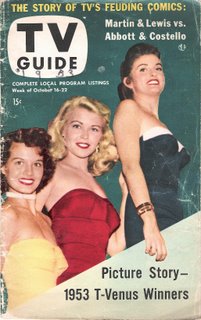
Yep - the brunette on the left. I may be wrong in ascribing this as Angie's first major public appearance, but I haven't seen anything earlier around the web this morning! This issue is from October 1953... and Angie was one of six winners of the "T-Venus" competition, for which the prize would be to appear on The Colgate Comedy Hour during the 1953-54 season. I haven't yet determined on which date(s) the appearance(s) took place, but perhaps a more savvy Angiephile has that information.
Wednesday, April 19, 2006
Hello, Angie Dickenson!
Friday, April 14, 2006
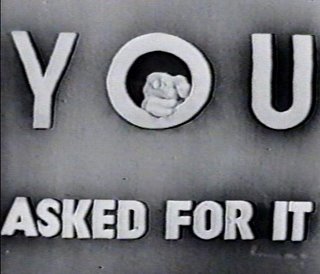
You Asked For It: The Our Gang Reunion
I once worked with a gentleman, retired from the business, who began his career as a production assistant on this show. He had a few stories to tell about Art Baker and producer Cran Chamberlain, which I'm sorry to say I've long forgotten, and he lamented the loss of a 16mm "blooper reel," which reportedly included some quick shots of Mr. Baker downing a few quick shots of his own from an ever-present flask, while off-stage. 
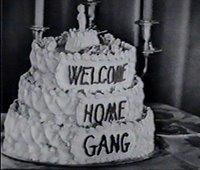
On one slow afternoon, I brought in the You Asked For It tape available from Shokus Video (now offered on DVD as well), and we watched it. My friend remembered that, like the big money quiz shows later in the decade, this little series was also partially "controlled" - or fixed, if you prefer. Unusual acts or stunts would be submitted to the producers, who would fabricate letters requesting these things, and it would be the faces of the production or clerical staff (including that of my friend, "more than once") that would appear on the Skippy Peanut Butter jars, representing these non-existent viewers.
The first episode on the tape was the one that closed with the reunion of the Our Gang kids from the silent era. First, a few pictures of the original Gang were shown.
From left to right, Jackie Condon, Joe Cobb, Mary Kornman, Mickey Daniels, Johnny Downs and Allen "Farina" Hoskins. Then came the reunion.
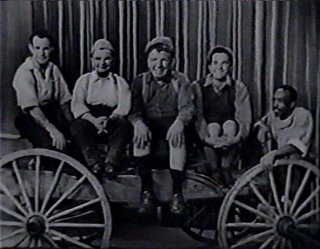
Ugh. Beanies and short pants. Baker announced that Mary Kornman was ill and unable to attend. That was our loss; a pretty face would certainly have been welcome among this motley bunch!
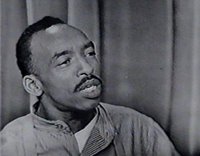
I asked my friend if the gang had been difficult to round up. He said no, but added that Farina was the easiest to locate: "He was working as a janitor for the building across the street from our studio."
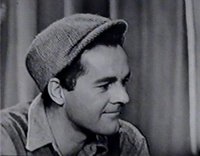
At the time, Johnny Downs was the only one still in show business - he'd just begun hosting his own children's show in San Diego.
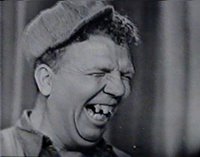
Mickey Daniels gave out his trademark horse laugh, displaying more than a few missing teeth. After this, none of the gang would ever see him again.
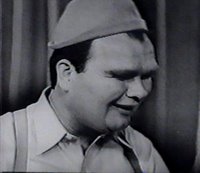
Joe Cobb and Jackie Condon had both left the business, although Jackie was still seeking work as an actor, without much luck. Not long after this, he'd give it up and join Joe in the aeronautic defense industry.
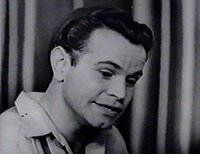
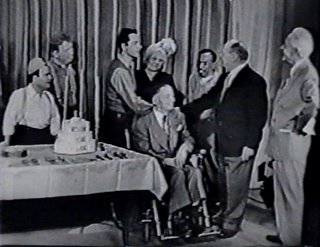
Then there were some surprises for the "kids":
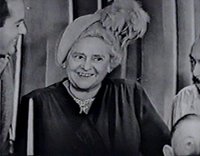
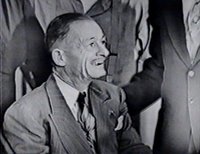
Mrs. Fern Carter, the gang's private teacher
...
cinematographer Art Lloyd...
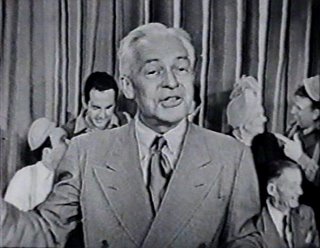
and Robert F. "Uncle Bob" McGowan, who directed the very
best Our Gang Comedies for over 15 years.
In their book The Little Rascals: The Life and Times of Our Gang, Richard K. Bann and Leonard Maltin refer to the You Asked For It reunion as "a slapdash affair... but a nostalgic treat nonetheless." Watching it over 50 years later, it seems more of the latter. Seeing Farina Hoskins and Johnny Downs respectfully greet Bob McGowan - their long-time director/father figure - is touching. Here was the man who shaped the template for all of the Gang incarnations to come. Look at the wagon
photograph, and simply replace Joe with Spanky, Mickey with Alfalfa, Mary with Darla, Jackie with Porky, Johnny with Butch, and Farina with Buckwheat.
Silent Our Gangs can be found on DVD from dealers such as Grapevine and Finders Keepers Video.
And so we leave Art Baker to close out this fond reminder of a classic group of films (which would not reach TV until about four years later), and some of the people who made them. Thank you, You Asked For It... whether or not any real viewer actually did.
Tuesday, April 11, 2006
Television Trivia Flashback
It's trivia time, folks!
A good friend sent me this insert, courtesy of Sara Lee cakes, that had appeared in a 1989 issue of People magazine, and I couldn't resist posting it.
All-in-all, it's a nice capsule history of the best of 1950's TV... although I can't imagine anyone selecting Father Knows Best over Leave it to Beaver as the "perfect TV family." Certainly Billy Gray, who played Bud Anderson, has made it known through the years that the lessons taught on Father Knows Best "were 180 degrees wrong." Ironically, in the plot described herein, the apparent moral is that deceit can be a good thing if it's used to reinforce the family.
I also have some quibbles with the fact-finding. A few urban legends, such as Vivian Vance's contractual obligation to remain 20 lbs heavier than Lucille Ball, and Jack Webb's non-utterance "Just the facts, ma'am," are reinforced. There's also this strange piece of Dragnet trivia: "From 1953 to 1955, Dragnet was syndicated as Badge 714 while Webb put the series on on hold to act in and direct films."
Badge 714 did begin in syndication in 1953, and Webb did produce Dragnet episodes ahead of schedule in order to further his theatrical feature ambitions, but one thing had nothing to do with the other.
On the plus side, the information about The Adventures of Superman is
spot on. The plot described is from "The Big Forget" (1957), my favorite episode as a child. It's wishful thinking on my part, but I'd sure love to be the "expert" who provides commentary for that episode on the final Superman box set. (Well, I did write an article about the 1957 season for Jim Nolt's The Adventures Continue fanzine. Does that help, Warner Brothers?)
Anyway, enjoy a piece of Sara Lee cheesecake as you read these pages. Oh, and the trivia questions (for which the answers are provided upside-down on the last 3 pages) are as follows:
1) What was "Beaver" Cleaver's true first name?
2) What is this marionette's first name? (Hint: in Texas, it means "Hello!")
3) Grandpa and the rest of the Munsters lived at what unlucky address?
Thursday, April 06, 2006
"Hail His Majesty the Sun!"

For the earliest members of the TV generation, this cartoon was omnipresent.
In his book, Of Mice and Magic, Leonard Maltin wrote that his childhood included "countless viewings" of The Sunshine Makers (1935). No less an authority than my mother vividly recalls it as one of the very first things she ever watched on television in 1952 - and that it was on practically all the time. Even after having not seen the cartoon for a half-century, she could still sing "Hail His Majesty the sun" perfectly.


The listing is from a New York City edition of TV Guide for June 1956, three years before I was born. I grew up in the NYC Metro area, but I don't recall Sunshine Makers, "Uncle Joe" or any kiddie shows on WABC, except maybe on Saturday mornings. I also don't remember cartoon titles being listed in TV Guide. It's nice to know that they once did that, just as it's nice to see that the stations had something for everybody during that half-hour - too bad there was only one set per TV household back then.
Once the major studios sold their cartoon libraries to TV, and stations got their hands on actual "stars" like Popeye, Bugs Bunny and Mighty Mouse, shorts like Sunshine Makers were consigned to oblivion.
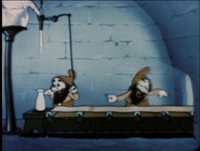
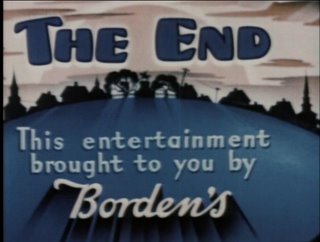
Sunshine Makers was apparently produced independently by Ted Eshbaugh in 1933 for the Borden company. I don't know an awful lot about Eshbaugh, except that he was one of the earliest animation directors to work with color, and that he'd done a lot of independent work - including a cartoon version of The Wizard of Oz, which I understand is an extra on Warner Brothers' DVD release of the classic Judy Garland feature.
Two years later, the Van Beuren Studios in New York City
released the film to theaters - their output was distributed by RKO Radio Pictures and Eshbaugh was now working there as a director - as part of their "Rainbow Parade" cartoon series. The ad shown is from April 1935 for the Ritz Theater in Anniston, Alabama. 
Fifteen years before U.P.A. was hailed for breakthroughs in the use of light, color and shadow in animation, this little gem was blazing the trail. Granted, it was hamstrung by the Cinecolor process, which only utilized blue and red tints. But I suspect that if a pristine 35mm print were to emerge, a few prominent film historians might sit up and take notice.
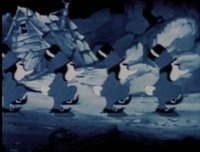
The story is simplicity itself. The happy elves harness the sun to produce "bottled sunshine." The gloomy elves ("We're happy when we're sad") that live in the dark forest next door try to stir up trouble. This leads to a full-fledged battle that they are destined to lose, for goodness and light will always triumph.

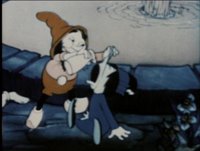
Van Beuren went out of business in 1937, just after RKO Radio signed a distribution deal with Walt Disney. The cartoon library was divvied up between several interested parties - Guaranteed Pictures, Commonwealth Pictures, Official Films; all ancient history now. Eventually, the Van Beuren films fell into the public domain, but thanks to the dollar DVDs you can find at Wal-Mart, Target or almost any $1 store, Sunshine Makers is once more omnipresent. Look for it - if you enjoy cartoons, it's a title well worth owning. 
Friday, March 24, 2006
Superman Goes to Color

The color episodes of "The Adventures of Superman" will be coming to DVD this year - perhaps a look at that landmark event (or "catastrophe," depending on your point of view) is in order.
Producer Whitney Ellsworth, having come from the comic book and pulp novel industries, recognized that Superman was a 4-color creation and deserved to be seen that way; if not now, then certainly by future generations. In 1954, when Ellsworth made the decision to shoot "Superman" in color, the value of syndicated reruns was just becoming evident. Ellsworth recognized that color was a wise investment - so did the sponsor, Kellogg's, which is why they agreed to help pay for it.
Of course, the color episodes weren't originally seen that way... "Superman" aired in black & white until the fall of 1965, six years after George Reeves died. There simply weren't enough color sets in operation through the '50's to justify the expense of manufacturing color dupe negatives and striking color prints for telecast. Only a few frames were printed at the time, so everyone behind the scenes could see what they were getting.
A few of these frames have survived, hence the above shot of George holding "the lily" on the set of "The Magic Secret." Naturally, these were printed on (cheap) Eastman stock... which is why Superman is turning red.
When color versions finally appeared in '65, the show's popularity exploded all over again. Almost overnight it shot into the top 5 of syndicated programs. Stations fell over each other trying to tie up the rights for their markets. Topps' bubble gum released a series of cards for the series - before that, who even knew that "Superman" publicity photos existed?
The color episodes have taken a lot of abuse over the years, as if the hues themselves are to blame. If the final 52 seem less dynamic, violent or downright interesting than the b&w seasons, color film is certainly not at fault. If anything, blame Dr. Fredrick Wertham's "Seduction of the Innocent" - the book that sparked a congressional investigation into comic book violence, of which Reeves himself owned a copy. The entire comics industry changed after that - violence, sexuality and gore were banned. Some companies, like National (D.C.), adapted. Others, like E.C., gave up the ghost. Since D.C. owned the "Superman" TV series, it stood to reason that the edict to tone down the stories would extend to those on film as well as in print.
In truth, there are some fine color episodes of "Superman," just as there are some awful b&w episodes ("My Friend Superman," anyone?). Check out the DVD set of seasons 3 & 4, to be released on June 20, and see for yourself.