Tuesday, September 28, 2021

September 29 is National Silent Movie Day!

 
As part of the Silent Movie Day Blogathon, Better Living Through Television comes out of semi-retirement to post about TV and its relationship with silent film.  Click on each image for a readable enlargement.

Vintage Mack Sennett comedies, of course, were seen in chopped-up highlights on HOWDY DOODY, and we've posted before on the silent animation that was being peddled by distributors for the earliest cartoon shows.  As adult programming, silent movies had a harder row to hoe... although, on the local level, a few brave souls gave them a chance.


On June 29, 1953, KRON-TV, San Francisco's NBC affiliate, aired THE EAGLE with Rudolph Valentino as a prime time entry.  No ratings info is available, although the fact that it was slotted opposite I LOVE LUCY's second season finale strongly suggests that it was not a success.

 
During the last third of 1956, Steve Allen reduced his TONIGHT SHOW duties to three days per week (Ernie Kovacs hosted the other two), and the show was cut back from 90 minutes to an hour.  WNBC in New York City took over the remaining half-hour with a local show called OLD, OLD STORY, consisting of early Hal Roach and Mack Sennett comedies, such as Sennett's LIZZIES OF THE FIELD (1924) and Roach's DODGE YOUR DEBTS (1921) (which starred Harold Lloyd's lesser known brother Gaylord).  The listing above is for November 30, 1956 and if you're a silent comedy expert but don't recall that title, it's actually FATTY AND MABEL ADRIFT (1916), with Roscoe "Fatty" Arbuckle reduced to "we'd better not publicize him so we don't get any nasty letters."

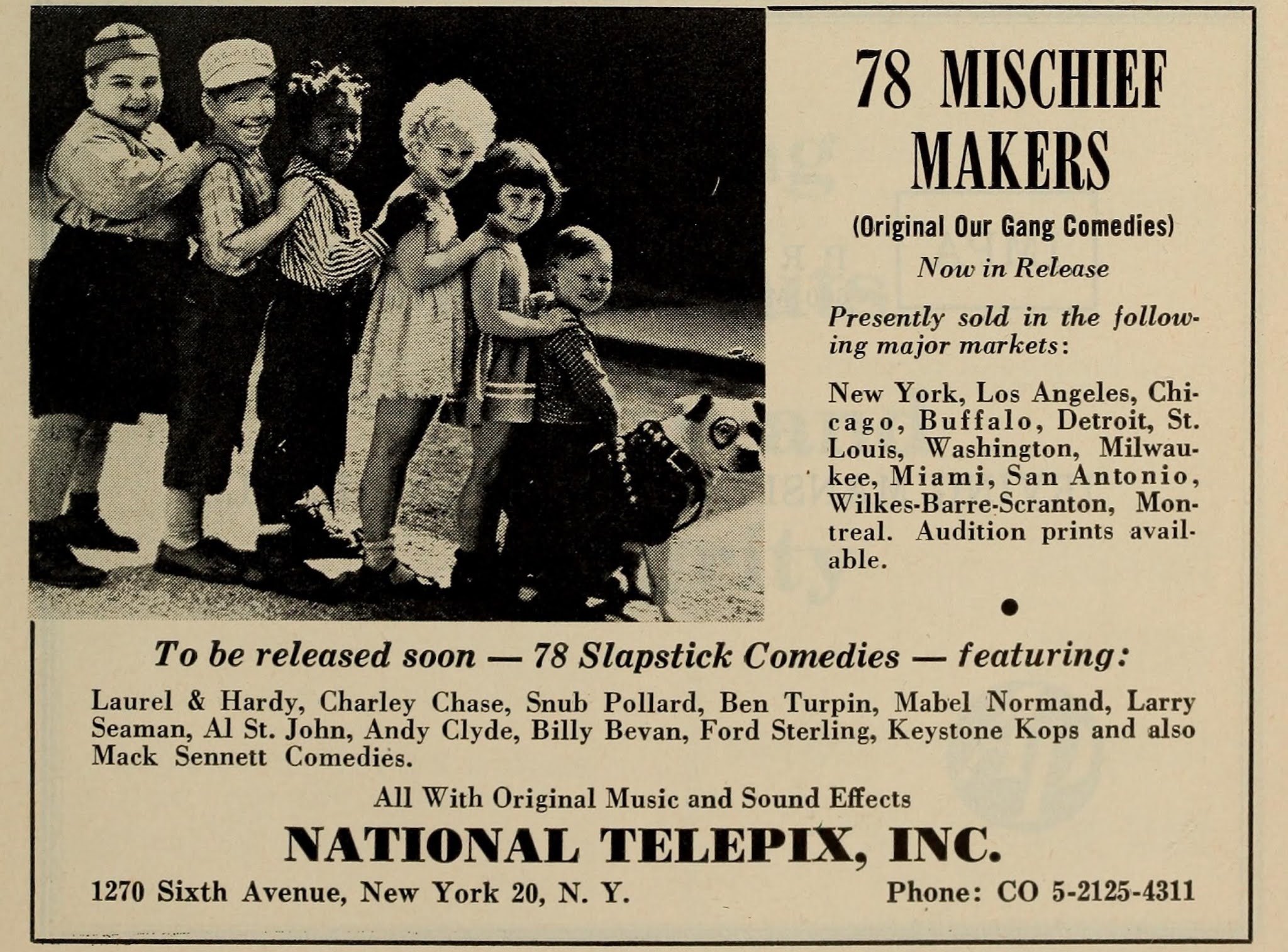
By 1961, Robert Youngson's two silent film compilations (THE GOLDEN AGE OF COMEDY and WHEN COMEDY WAS KING) had proved to be huge draws for kids, while on TV, both the Hal Roach "Little Rascals" and MGM "Our Gang" sound shorts were big successes.  National Telepix put together two 78-episode series culled from various silent comedy series.  The first, MISCHIEF MAKERS, came mainly from the silent Our Gang series produced by Roach.  The second series, still untitled in this trade ad, was eventually called COMEDY CAPERS (featuring "Larry Seaman" among other unknowns).


The early sixties also presented some silent-based prime time shows of varying quality.  FLICKER FLASHBACKS, produced by Jay Ward and his TV cartoon crew, used snippets from comedies, dramas and action pictures assembled in a half-hazard, frantic pace, along with "dialogue" and narration chock full of cheap laughs.  More respectfully, SILENTS PLEASE used vintage footage to pay homage to the era and its stars.  Neither series lasted very long.


When network TV gave up on silents, public (or educational) television picked up the slack.  The WTTW, Chicago-produced series THE TOY THAT GREW UP, which debuted in July 1968, presented uncut features and short subjects in the same respectful manner as SILENTS PLEASE.  Befitting its Public TV origins, host Don Ferris provided background information about the films and their stars.


My initial exposure to Charlie Chaplin was in the November 9, 1969 broadcast of Youngson's 3rd feature, THE DAYS OF THRILLS AND LAUGHTER (1961).  As I freely admitted in its introduction, my book CHAPLIN'S VINTAGE YEAR got its title from the narration in this terrific compilation.  I'm certain the excited 10-year-old that I was sat joyously in front of the set on this Sunday afternoon... and just as certain that I was not permitted to stay up for the 8:30 PM rebroadcast, given I had school the next morning!

Around that same time, New York's Public TV station WNET-13 would run Chaplin comedies regularly on weekday afternoons during Christmas break and in the summer.  These shows were hosted by Herb Graff, a faculty member of NYU and well-known silent comedy aficionado.  In July 1973, Graff and WNET expanded the scope of this programming with a series that highlighted several comedians.  This series provided my first exposure to Buster Keaton and Harry Langdon.


Television's best-known silent film program is probably THE SILENT YEARS, produced for Public TV by renowned film collector and historian Paul Killiam (who'd been one of the contributors to SILENTS PLEASE), which debuted in NYC in July 1971. (What was it about July that Public TV thought ideal for silent film programming?)  Fondly remembered for William Perry's fine piano scores and the erudite Orson Welles as host, THE SILENT YEARS introduced many future historians not only to comedic gems such as THE GOLD RUSH (1925) and THE GENERAL (1926), but also terrific exemplars of silent action-adventure (THE MARK OF ZORRO, 1920) and drama (ORPHANS OF THE STORM, 1922).

Sunday, January 18, 2015

Speaking of the Marx Brothers...

TONIGHT: America After Dark (NBC, Jan-July 1957) is pretty much regarded as one of television's great disasters.  After Steve Allen and Ernie Kovacs gave up their respective hosting duties of the original TONIGHT! at the end of 1956, NBC's Pat Weaver tried turning it into a nocturnal TODAY show, with news, interviews and on-the-spot reporting of the country's night life, from coast-to-coast.  Unfortunately, most of America had little interest in seeing what celebrities were up to while the rest of us working stiffs prepared to turn in.  Ratings plummeted, and the network opted to get back to the original format of variety and talk, tapping Jack Paar to host.  America After Dark went to that cathode ray graveyard where few have mourned it since.

One segment, however, is hotly desired by classic comedy fans.  Chico Marx of the Marx Brothers had been touring in a play, Sylvia Regan's The Fifth Season, and he and the stock company would appear in Los Angeles beginning Monday evening, February 18.  His four younger brothers, Harpo, Groucho, Gummo and Zeppo, would be in the audience, and NBC arranged for cameras and one of their emcees to be in Chico's dressing room for an informal post-performance reunion.

To date, a kinescope has failed to turn up; all that exists are these five photographs taken during the course of the segment (or perhaps just before/after its telecast).  Considering its plugging by newspaper TV columnists, who ordinarily had no interest in this show, it's entirely possible that someone, somewhere has a reel of audiotape with the soundtrack.  Check your archives, folks!


Saturday, July 12, 2014

Answering GREENBRIAR PICTURE SHOWS

Yesterday my buddy John McElwee posted a gorgeous vintage newspaper ad from the pre-Chico era of The Marx Brothers in vaudeville on his terrific blog, asking "if there are any earlier newspaper ads with Marx imagery."  I've not seen originals, of course, but have plumbed the depths of newspaper databases, mainly for my own entertainment but also with one eye toward a possible Marx tome.  Here's a sampling of what emerged:


This is from the Atlanta Constitution of Valentine's Day 1909; a mere 105 years ago, when the three Marxes were the Four Nightingales.  That's Gummo, Lou Levy, Groucho and Harpo in the lower right photo.  

Just ten months earlier they were two Marxes (sans Harpo) and Three Nightingales, here advertised in the Fitchburg (NY) Sentinel of  April 16, 1908.  Apparently, and despite the legend, comedy was a fixture of their act early on, hence the sub-billing as "The Merry Funsters"... or is it "Punsters"?  (Probably not; no Chico yet.)

The titles listed at top were not acts, but the ditties to be featured in the "illustrated songs" portion.  (If not for that last one, I would've been at a complete loss.)


In Harpo Speaks, the "silent" brother's massive autobiography, an otherwise forgotten vaudevillian named Mons Herbert makes a cameo appearance.  Mr. Herbert was evidently prone to wager his meager salary at the card table, which delighted Harpo as the poor fellow had a habit of tipping the quality of his hand by the number of gold teeth he'd flash.  Onstage, according to Harpo, Herbert "blew up a turkey until music came out of its ass."  This, as you can see, is barely hinted at in an ad for Waterloo Iowa's Orpheum bill of March 14, 1911.  (Note too that in this early stage Fun in Hi Skool was also tltled "Skool Goils and Boiz.")


As is well known among Marxologists, Groucho - Julius, actually - was the first of the brothers to appear on stage.  One of his earliest gigs was in support of Lily Seville in something called The Lady and the Tiger.  This ad is from the San Antonio Gazette of January 6, 1906. Although their act is touted as "direct from Paris," Miss Seville and 15-year-old Master Marx are listed among the extra attractions at bottom, just before the illustrated songs and "Kinetograph Views," a pretentious term for "flickers."

My own favorite discovery comes from much later, when the Four Marx Brothers that we're used to seeing traveled to England in May 1922 - a journey that got them blackballed from big time vaudeville because they didn't clear it through the Keith-Orpheum booking office, which itself led indirectly to I'll Say She Is and Broadway stardom.  Ancestry.com has yielded the brothers' passport photos.  Chico and Groucho are each accompanied by the missus (evidently wives didn't get their own passports in 1922), while bachelors Zeppo and Harpo - the latter looking like he'd been out all night partying before sitting for his picture - are solo.

Wednesday, February 12, 2014

So Long, Shirley

Shirley Temple, who passed away at age 85 this past Monday, was twice a showbiz phenomenon.  The first reign has been pretty well covered by the obits: in the space of two years (1933-34) she shot like a rocket from "leading lady" of Educational Pictures' execrable "Baby Burlesk" one-reelers to number one box office attraction in the country, then held that position for four years straight.

Picture Play, 1934
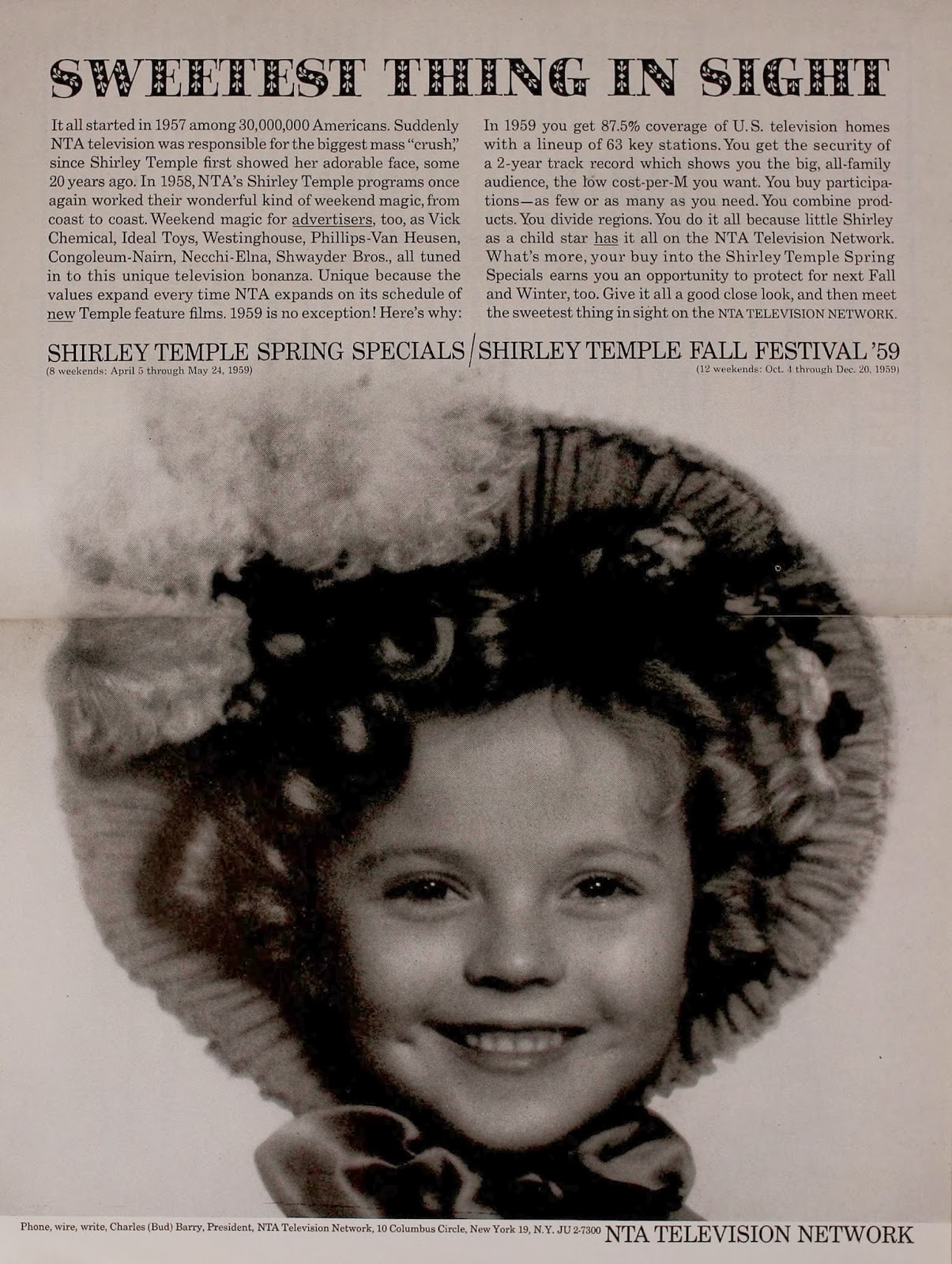
Her second rise is less well-covered.  In 1957, National Telefilm Associates (NTA), looking to build its own syndication network, leased a block of pre-'48 features from 20th Century-Fox, including four of Shirley's: Captain January, Wee Willie Winkie, Heidi and Rebecca of Sunnybrook Farm.  These were extracted from the main package and offered as "The Shirley Temple Film Festival" to national advertisers.  Ideal Toys immediately signed on for one-third of the package.  Reaction was so solid, NTA immediately added Poor Little Rich Girl and Little Miss Broadway to the lineup.  By mid-1961, all of Shirley's Fox product was on the air, and local stations would keep the "Temple Film Festival" active into the 1970s.

My own experience was on Metromedia's WNEW-5 in New York City.  In my preadolescence, Shirley graced Saturday afternoons as reliably as did Leo Gorcey and Huntz Hall on Sundays for channel 5's "East Side Comedy" hour.

Ken Films' releases were worth buying for the covers alone!
          Like any red-blooded youth, I developed a crush on the dimpled darling, albeit aware that it not only transcended distance but time as well.  The closest I could get to everyday company with Shirley was via Ken Films' 8mm releases of four Baby Burlesk titles.  The genuine Shirley Temple was by then engaged in her second vocation with the United Nations and was about to become - most unexpectedly - an empathetic torch carrier for sufferers of breast cancer.

When her films first tallied up huge ratings and grosses in the late fifties, she signed on for a fairy tale program, Shirley Temple's Storybook, broadcast in color on NBC.  Several of the tapes survive and were released to DVD in recent years, but as forshadowed by this 1958 TV GUIDE cover, it's the original, Depression-era Shirley that still gets the glory... and likely always will.

Wednesday, November 20, 2013

Unfortunate Timing for TV Guide

It must've been a shock when viewers, consulting TV Guide for December 4, 1963, got an eyeful of this listing for The Kennedy Awards.  The President, who'd been shot and killed in Dallas on November 22, had been scheduled to appear on this live broadcast of the awards named for his late elder brother.

Needless to say, this was one show that didn't go on, local Metromedia stations subbing it with movies from their libraries.  The issue in which this listing appeared went on sale the Thursday following the national - indeed, global - tragedy.  If nothing else, it was a sobering lesson to a still-grieving public on how far in advance the listings section of the Guide went to press.

The 50th anniversary of John F. Kennedy's assassination this weekend is, naturally, being marked with various tributes, news specials and documentaries.  Many will focus on the man, others on the event.  Hopefully time will be taken as well to speak of the masterful job television did in covering that horrific day and its aftermath.  At least one hard-boiled TV critic, on the day the Kennedy Awards were to have aired, took time to toss a bouquet to the medium that set aside its "vast wasteland" for four days and united a planet in sorrow and tried to expedite its first steps toward healing.

A few weeks later, TV Guide would more than atone for its unintended gaffe with a commemorative issue recounting everything that had transpired before our eyes.


(A prior BLTT post looks at some of the programming that had been originally scheduled that weekend.)


Saturday, November 09, 2013

The post-theatrical life of the Mutual-Chaplin Specials


Poised to ship upon receipt of orders, the good folks at BearManor Media have just published my latest book: CHAPLIN’S VINTAGE YEAR: The History of the Mutual-Chaplin Specials.  Silent comedy aficionados need no introduction to this subject.  For casual viewers: these are twelve 2-reel comedies produced by Chaplin during 1916-17 that, quite frankly, have been viewed by more eyes than any other cinematic work.  Consider (at risk of morbidity): cemeteries are choked with millions who didn’t live to see The Sound of Music, much less Star Wars or Harry Potter, yet queued up at their local nickelodeon box office, dimes in hand, just to watch these films, often more than once. 

During their first release cycle between 1916-18, they grossed $3.3 million when admissions were, on average, .10-.15 cents.  They came around again, with new prints each time, in 1919, 1923, 1927, 1932 (with music and sound courtesy of the Van Beuren studio’s Gene Rodemich and Winston Sharples), 1941 (in two “streamlined” feature compilations of six shorts each) and beyond, right up to today.  Search “Chaplin Mutual” on YouTube; you’ll find them.  CHAPLIN’S VINTAGE YEAR covers not only the making of those dozen gems, but their selling (and re-selling) as well, into the 21st century, and the restoration and Blu-ray release that is coming next year. 

Naturally, that history includes television.  There’s a bit more that can be told on that subject, for which this blog is the perfect forum.

In March 1941, RKO Radio Pictures, which had acquired the Chaplin Specials from its former shorts supplier the Van Beuren Corporation, sold the negatives to Guaranteed Pictures Inc.  Guaranteed had been formed in 1928 by Samuel Goldstein and Mortimer Sikawitt, and mainly distributed independent features, mostly foreign-made.  Four years after its founding, the company financed the first Yiddish-language talking feature, Joseph in the Land of Egypt.  It was mainly a labor of love, yet hit big among its target audience, especially in Poland.

Typical low-budget Commonwealth fare.
Eager to get into the non-theatrical business, by 1937 Goldstein and Sikawitt (who’d soon change his name to Mort Sackett) founded Commonweath Pictures Corporation for 16mm road show distribution and home movie sales.  They bought up theatrical films, mostly low-budget scraps from dead studios or independent productions that had been released by United Artists and RKO.  Naturally, after Guaranteed acquired the Chaplin Specials, Commonwealth was assigned non-theatrical rights.  In 1947, the company branched into TV with Commonwealth Film and Television, simply licensing its properties for the home screen.

Guaranteed had issued their two feature compilations in April and August of 1941; limited releases to be sure, but all enormously successful.  In early 1943, Commonwealth took the two 6-short features and reworked them into three 4-short featurettes for non-theatrical release, and also made each individual short available. 

Like every other buyer of the Mutual Chaplins, though, Guaranteed needed to aggressively assert its legal ownership of the titles, as hundreds of stray prints were still floating around for sale or lease.  In January 1942, action was brought against the Movie Parade Theater in Los Angeles for unauthorized showing of a Mutual short.  Theater owner Edward Kohn was forced to pony up $3,500 in damages for screening his own 16mm print of one film!

Notice in the May 6, 1941 issue of FILM DAILY.
Unfortunately, no one seems to have told Goldstein, Sackett or their lawyer that copyrights needed to be renewed after 28 years.  The Van Beuren versions were never registered, despite the synchronizing of music and sound that effectively turned them into “new works.”  Consequently the Mutual-Chaplins slipped into the public domain in the mid-1940s, and there was little that Guaranteed or Commonwealth could do about it, not that they didn’t try.

Mort Sackett tries to assert his no-longer-applicable rights to the Mutual-Chaplins in 1959.
Luckily, Commonwealth was a major TV distributor, thanks mostly to their prodigious cartoon library, and it helped that they had the best-looking elements on the Chaplin subjects.  It doubly helped that they never bothered making dupe or 16mm negatives, striking 16mm prints straight off the original 35mm pre-print materials.  Naturally this came at a cost to their eventual preservation, but that was nobody’s concern in the late 1940s. 

TV distribution of the Chaplins began around 1950.  In November of that year, Goldstein died in a horrific crash on the Long Island Railroad, and it was the beginning of the end for Commonwealth and Guaranteed.  Three years later, Goldstein’s heirs would (unsuccessfully) sue for control of the companies, claiming Sackett and his wife (who served as treasurer) were intentionally mismanaging in order to lower share value.  In truth, Sackett was just incompetent; “one of those bullying, cigar-chewing types,” according to film preservationist David Shepard, who met him in the 1960s.  Before cashing out at the end of that decade, all Commonwealth properties would wind up in public domain hell.  You’ve seen their titles over and over in the dollar bin: The Flying Deuces, Pot o’ Gold, Second Chorus, ad infinitum.

Chaplin’s history on early TV was rather spotty.  He was a big hit in Los Angeles, but owing to the legal and political allegations then hounding him, veterans and women’s groups in other cities, including New York, forced his films from the air.  By the end of the decade that opposition began to recede and the Little Tramp gradually made his way back to the tube.  
 
 In 1963, New York City’s WOR-TV licensed the three Commonwealth compilations for their Million Dollar Movie program, and held those rights for at least three years.  The individual shorts turned up on public television.  By 1972, of course, all was forgiven and Chaplin returned to the U.S. in triumph to receive a special Academy Award.

Eventually Blackhawk Films bought the surviving Commonwealth elements, which is another story, covered in detail in CHAPLIN’S VINTAGE YEAR.

Sunday, August 18, 2013

BLUE RIBBON BLUES


By April 1943, Leon Schlesinger realized he could no longer keep up the pace.  The producer who’d delivered 39 cartoons annually for the previous four seasons was looking at a staff sharply reduced by war service coupled with an obligation to provide “Private SNAFU” cartoons for the Signal Corps, plus his own declining health, and decided to cut his theatrical output by a third.  However, his distributor, Warner Bros., wanted to keep 39 reels in the annual pipeline.  Thus was born the BLUE RIBBON HIT PARADE.

The Blue Ribbon releases are the bane of animation historians and purists.  At least 279 cartoons were reissued under this banner, and of these, 160 were completely shorn of their original title and credit cards.  In fact, no credits whatsoever appear on these eight score, and the cuts were evidently made on their original negatives - a fact that sent the earliest Warner animation scholars into conniptions that still resonate in their nervous systems.  Yet the series has its own story, one that speaks to the strength of Schlesinger’s output.

For one thing, thirteen annual Blue Ribbons carried a lower price tag than the Looney Tunes/Merrie Melodies series.  This enabled independent houses that otherwise couldn’t afford a Warner package to score some of the funniest shorts on the market.  The first series, introduced in September 1943, was particularly golden: nine of the thirteen titles had been directed by Fred “Tex” Avery, currently tearing up Loew’s theater screens with his MGM output; and the group even included two Bugs Bunnys: HIAWATHA’S RABBIT HUNT (1941) and A WILD HARE (1940), each an Academy Award nominee.

In order to make up the lost revenue, new Bugs Bunny titles were removed from the standard Merrie Melodies program beginning in February 1944, and given a series of their own: the Bugs Bunny Specials.  These, naturally, sold for a higher price.  Furthermore, Bugs’s output was exempted from the reissue series; if you wanted one of his older titles, you could just book it separately at full price.  After the first season of releases, the wascally wabbit wouldn’t return to the Hit Parade until 1957.

Blue Ribbons were the first cartoons to be reissued in a program of their own, and their success led others to draw from the same well.  Paramount tried reviving the Max Fleischer Color Classics in January 1945, but this didn’t last beyond four titles.  Next, Columbia’s Color Favorites debuted in October 1947, as did reissues of Disney cartoons by R.K.O., which were not part of a separate series.  MGM followed suit in November with their Gold Medal Reprints series.  Starting in 1948, Universal-International reissued Walter Lantz “Cartunes” during the period Lantz was contracted to United Artists, and continued doing so after he returned.  That same year, 20th Century-Fox began mixing reissues into their program of Terrytoons releases.  In October 1949, Paramount tried again, inaugurating the Champions series, consisting mainly of Noveltoons from earlier in the decade.  After a year, color Popeye cartoons were substituted, and the series was eventually renamed Popeye Champions.

At the conclusion of production for the 1943-44 season, Schlesinger sold his studio directly to Warner Bros.  The company initially announced that the “Looney Tunes” and “Merrie Melodies” monikers would be dropped in favor of a “Warner Bros. Cartoon” logo for all.  That idea was scrapped, but from this point on the two series would be interchangeable.  Although the Tunes had graduated to full color the year before, Schlesinger had kept Porky Pig and Daffy Duck as their stars, while Bugs headlined in the Melodies.  The Blue Ribbons would eventually reissue color Looney Tunes titles, but the series itself would always be heralded under the Melodies banner.

During the course of the 1955-56 release season, Warner Bros. sold off their pre-’48 library, including color cartoons, to a television distributor, Associated Artists Productions (a.a.p.).  Some of the titles included in the deal were then in distribution as Blue Ribbons.  With the 1956-57 season, the reissues would be limited to those copyrighted during or after September 1948, and it was at this point the decision was made to keep the original title and credit cards on view; only the opening rings and Merrie Melodies cards would be replaced.  Original end titles could remain, even if they closed under the Looney Tunes banner, because there was no longer a need to replace cards that had credited Schlesinger.

Beginning in September 1957, the season Bugs returned, the annual Blue Ribbon output would grow to 16 titles.  The series kept to this schedule until (apparently) the 1961-62 season, when it shrank back to thirteen.  The Hit Parade, along with all classic Warner cartoons, finally came to an end after the 1963-64 release season.  After this, the cartoon studio closed its doors for a while, reopening briefly in the mid-1960s for some mostly abysmal productions that mercifully ceased at the end of the decade.

Following is hopefully a complete list of Blue Ribbon releases, mostly in order of reissue date.  Eight titles received two separate Blue Ribbon issues, which are noted.  Most of this information, including production numbers, derives from the “Shorts Chart” published in the pages of BOX OFFICE magazine, with the following exceptions: 

Beginning with the 1955-56 season, the Shorts Chart only published release month for the cartoons.  For this and the following season, the exact release dates were taken from David Mackey’s excellent WARNER BROS. CARTOONS FILMOGRAPHY AND TITLE CARD GALLERY website.  Mackey’s listings also identified the final three titles of the 1956-57 season and the first three titles of the 1957-58 season, which never appeared in the Chart.  Lastly, my thanks to Dave Mackey for providing the last five titles of the 1959-60 season in a recent comment.

BOX OFFICE did not publish the first five titles of the 1962-63 season.  The list concludes with 7 titles that Mackey has identified as Blue Ribbons from the 1959-64 period, five of which presumably slot into the open spaces.  The two “leftover” titles are, at present, a mystery.


1943-44 ("Blue Ribbon Cartoon Reissues"): 
9301: A Feud There Was  (11-Sept-1943)
9302: The Early Worm Gets the Bird (02-Oct-1943)
9303: My Little Buckaroo (06-Nov 1943) mis-titled “My Little Buckeroo”
9304: The Fighting 69-1/2th (04-Dec-1943)
9305: Cross-Country Detours (15-Jan-1944)
9306: Hiawatha’s Rabbit Hunt (12-Feb-1944)
9307: The Bear’s Tale (11-Mar-1944)
9308: Sweet Sioux (08-Apr-1944)
9309: Of Fox and Hounds (13-May-1944)
9310: Thugs with Dirty Mugs (03-Jun-1944)
9311: A Wild Hare (17-Jun-1944) mis-titled “The Wild Hare”
9312: The Cat Came Back (15-Jul-1944)
9313: Isle of Pingo Pongo (19-Aug-1944) 

1944-45:
1301: Let It Be Me (16-Sep-1944)
1302: September in the Rain (30-Sep-1944)
1303: Sunday Go to Meetin’ Time (28-Oct-1944)
1304: I Love to Singa (18-Nov-1944)
1305: Plenty of Money and You (09-Dec-1944)
1306: The Fella With a Fiddle (20-Jan-1945)
1307: When I Yoo Hoo (24-Feb-1945)
1308: I Only Have Eyes for You (17-Mar-1945)
1309: Ain’t We Got Fun (21-Apr-1945)
1310: I’m a Big Shot Now (04-Jun-1945)
1311: Speaking of the Weather (21-Jul-1945)
1312: Old Glory (25-Aug-1945)
1313: Busy Bakers (20-Oct-1945) 

1945-46 (Now called the “Blue Ribbon Hit Parade”):
2301: A Sunbonnet Blue (17-Nov-1945)
2302: The Lyin’ Mouse (22-Dec-1945)
2303: The Good Egg (05-Jan-1946)
2304: The Trial of Mr. Wolf (09-Feb-1946)
2305: Little Lion Hunter (23-Mar-1946)
2306: Fresh Fish (06-Apr-1946)
2307: Daffy Duck and Egghead (20-Apr-1946)
2308: Katnip Kollege (04-May-1946)
2309: The Night Watchman (18-May-1946)
2310: Little Brother Rat (08-Jun-1946)
2311: Johnny Smith & Poker Huntas (22-Jun-1946)
2312: Robin Hood Makes Good (06-Jul-1946)
2313: Little Red Walking Hood (17-Aug-1946) 

1946-47:
3301: Fox Pop (28-Sep-1946)
3302: The Wacky Worm (12-Oct-1946)
3303: You’re an Education (26-Oct-1946)
3304: Have You Got Any Castles? (01-Feb-1947)
3305: Pigs is Pigs (22-Feb-1947)
3306: The Cat’s Tale (29-Mar-1947)
3307: Goofy Groceries (19-Apr-1947)
3308: Doggone Modern (14-Jun-1947)
3309: The Sneezing Weasel (26-Jul-1947)
3310: Rhapsody in Rivets (16-Aug-1947)
3311: Sniffles Bells the Cat (20-Sep-1947)
3312: Cagey Canary (11-Oct-1947)
3313: Now That Summer is Gone (22-Nov-1947) 

1947-48:
4301: Dangerous Dan McFoo (30-Jan-1948)
4302: Hobo Gadget Band (14-Feb-1948)
4303: Little Pancho Vanilla (20-Mar-1948)
4304: Don’t Look Now (10-Apr-1948)
4305: The Curious Puppy (24-Apr-1948)
4306: Circus Today (22-May-1948)
4307: Little Blabber Mouse (12-Jun-1948)
4308: The Squawkin’ Hawk (10-Jul-1948)
4309: A Tale of Two Kitties (31-Jul-1948)
4310: Pigs in a Polka (14-Aug-1948)
4311: Greetings Bait (28-Aug-1948)
4312: Hiss and Make Up (18-Sep-1948)
4313: Hollywood Steps Out (02-Oct-1948) 

1948-49:
5301: An Itch in Time (30-Oct-1948)
5302: Fin ‘n’ Catty (11-Dec-1948)
5303: Bedtime For Sniffles (01-Jan-1949)
5304: Prest-o Chang-o (05-Feb-1949)
5305: Swooner Crooner (12-Feb-1949)
5306: Hop, Skip and a Chump (05-Mar-1949)
5307: He Was Her Man (02-Apr-1949)
5308: I Wanna Be a Sailor (20-Apr-1949)
5309: Flop Goes the Weasel (21-May-1949)
5310: Horton Hatches the Egg (18-Jun-1949)
5311: The Egg Collector (16-Jul-1949)
5312: The Mice Will Play (06-Aug-1949)
5313: Inki and the Mynah Bird (20-Aug-1949) 

1949-50:
6301: Tom Thumb in Trouble (24-Sep-1949)
6302: Farm Frolics (15-Oct-1949)
6303: The Hep Cat (12-Nov-1949)
6304: Toy Trouble (31-Dec-1949)
6305: My Favorite Duck (28-Jan-1950)
6306: The Sheepish Wolf (04-Mar-1950)
6307: Double Chaser (25-Mar-1950)
6308: Fifth Column Mouse (22-Apr-1950)
6309: Inki and the Lion (20-May-1950)
6310: Tick Tock Tuckered (03-Jun-1950)
6311: Booby Hatched (01-Jul-1950)
6312: Trap Happy Porky (05-Aug-1950)
6313: Lost and Foundling (26-Aug-1950) 

1950-51:
7301: Fagin’s Freshmen (16-Sep-1950)
7302: Slightly Daffy (14-Oct-1950)
7303: The Aristo-Cat (11-Nov-1950)
7304: The Unbearable Bear (09-Dec-1950)
7305: Duck Soup to Nuts (06-Jan-1951)
7306: Flowers for Madame (03-Feb-1951)
7307: Life With Feathers (03-Mar-1951)
7308: Peck Up Your Troubles (24-Mar-1951)
7309: Odor-Able Kitty (21-Apr-1951)
7310: Book Revue (19-May-1951) mis-titled “Book Review”
7311: Stage Fright (23-Jun-1951)
7312: Sioux Me (21-Jul-1951)
7313: The Stupid Cupid (01-Sep-1951) 

1951-52:
8301: Holiday for Shoestrings (15-Sep-1951)
8302: The Lady in Red (13-Oct-1951)
8303: Sniffles and the Bookworm (10-Nov-1951)
8304: Goldilocks and the Jivin’ Bears (01-Dec-1951)
8305: Of Thee I Sting (12-Jan-1952)
8306: From Hand to Mouse (09-Feb-1952)
8307: Brave Little Bat (15-Mar-1952)
8308: Snow Time for Comedy (12-Apr-1952)
8309: Hush My Mouse (03-May-1952)
8310: Baby Bottleneck (14-Jun-1952)
8311: The Bug Parade (12-Jul-1952)
8312: Merrie Old Soul (02-Aug-1952)
8313: Fresh Airedale (30-Aug-1952) 

1952-53:
9301: A Feud There Was (13-Sep-1952) 2nd BR release
9302: Daffy Doodles (11-Oct-1952)
9303: A Day at the Zoo (08-Nov-1952)
9304: The Early Worm Gets the Bird (29-Nov-1952) 2nd BR release
9305: A Tale of Two Mice (10-Jan-1953)
9306: The Bashful Buzzard (07-Feb-1953)
9307: The Country Mouse (14-Mar-1953)
9308: Little Dutch Plate (11-Apr-1953)
9309: Ain’t That Ducky (02-May-1953)
9310: Mighty Hunters (13-Jun-1953) (1st BR to retain the original title and credit card)
9311: The Fighting 69-1/2th (11-Jul-1953) 2nd BR release
9312: Sniffles Takes a Trip (01-Aug-1953)
9313: Wacky Wildlife (29-Aug-1953) 

1953-54: 
1301: Old Glory (12-Sep-1953) 2nd BR release
1302: Walky Talky Hawky (17-Oct-1953)
1303: Birth of a Notion (07-Nov-1953)
1304: Eager Beaver (28-Nov-1953)
1305: Scent-Imental Over You (26-Dec-1953)
1306: Of Fox and Hounds (06-Feb-1954) 2nd BR release
1307: Roughly Squeaking (27-Feb-1954)
1308: Hobo Bobo (03-Apr-1954)
1309: Gay Antics (24-Apr-1954)
1310: The Cat Came Back (05-Jun-1954) 2nd BR release
1311: One Meat Brawl (10-Jul-1954)
1312: Along Came Daffy (24-Jul-1954)
1313: Mouse Menace (14-Aug-1954) 

1954-55:
2301: Rhapsody in Rivets (11-Sep-1954) 2nd BR release
2302: Inki at the Circus (16-Oct-1954)
2303: Foxy Duckling (06-Nov-1954)
2304: The Shell-Shocked Egg (27-Nov-1954)
2305: The Trial of Mr. Wolf (25-Dec-1954) 2nd BR release
2306: Back Alley Oproar (05-Feb-1955)
2307: You Were Never Duckier (26-Feb-1955)
2308: House Hunting Mice (02-Apr-1955)
2309: Crowing Pains (23-Apr-1955)
2310: Hop, Look and Listen (04-Jun-1955)
2311: Tweetie Pie (25-Jun-1955)
2312: Goofy Gophers (23-Jul-1955)
2313: What’s Brewin’ Bruin? (20-Aug-1955) 

1955-56 (final season in which credits were eliminated):
3301: Doggone Cats (10-Sep-1955)
3302: The Rattled Rooster (22-Oct-1955)
3303: Fair and Worm-er (5?-Nov-1955)
3304: The Mouse-Merized Cat (26-Nov-1955)
3305: The Foghorn Leghorn (24-Dec-1955)
3306: Bone, Sweet Bone (21-Jan-1956)
3307: I Taw a Putty Tat (25-Feb-1956)
3308: Two Gophers from Texas (31-Mar-1956)
3309: Kit for Cat (21-Apr-1956)
3310: Scaredy Cat (02-Jun-1956)
3311: A Horsefly Fleas (07-Jul-1956)
3312: Little Orphan Airedale (04-Aug-1956)
3313: Daffy Dilly (18-Aug-1956) 

1956-57 (First with original title cards and credits intact):
4301: Mouse Mazurka (15-Sep-1956)
4302: Paying the Piper (20-Oct-1956)
4303: Daffy Duck Hunt (17-Nov-1956)
4304: Henhouse Henery (01-Dec-1956)
4305: Swallow The Leader (19-Jan-1957)
4306 For Scent-imental Reasons (02-Feb-1957)
4307: Mouse Wreckers (09-Mar-1957)
4308: Dough for the Do-Do (06-Apr-1957)
4309: Fast and Furry-ous (27-Apr-1957)
4310: Bear Feat (18-May-1957)
4311: Each Dawn I Crow (15-Jun-1957)
4312: Bad Ol’ Putty Tat (29-Jun-1957)
4313: Hippety Hopper (24-Aug-1957) 

1957-58:
5301: Hare Splitter (Sept? 1957)
5302: Pop ‘Im Pop! (Oct? 1957)
5303: His Bitter Half (Oct? 1957)
5304: The Leghorn Blows at Midnight (Nov 1957)
5305: The Pest That Came to Dinner (Dec 1957)
5306: The Hypo-Chondri-Cat (Dec 1957)
5307: Home, Tweet Home (Jan 1958)
5308: Mississippi Hare (Feb 1958)
5309: Caveman Inki (Mar 1958)
5310: It’s Hummer Time (Mar 1958)
5311: A Fractured Leghorn (Apr 1958)
5312: The Scarlet Pumpernickel (May 1958)
5313: All A-bir-r-r-d! (Jun 1958)
5314: Awful Orphan (Jul 1958)
5315: Rebel Rabbit (Aug 1958)
5316: Stooge for a Mouse (Aug 1958) 

1958-59:
6301: Bowery Bugs (Sept 1958)
6302: An Egg Scramble (Oct 1958)
6303: Wise Quackers (Oct 1958)
6304: Two’s a Crowd (Nov 1958)
6305: Canary Row (Dec 1958)
6306: Dog Collared (Jan 1959)
6307: Fox in a Fix (Jan 1959)
6308: My Bunny Lies Over the Sea (Feb 1959)
6309: Golden Yeggs (Mar 1959)
6310: Scent-imental Romeo (Mar 1959)
6311: Canned Feud (May 1959)
6312: Early to Bet (May 1959)
6313: Boobs in the Woods (Jun 1959)
6314: The Bee-Deviled Bruin (Jul 1959)
6315: High-Diving Hare (Jul 1959)
6316: Doggone South (Aug 1959) 

1959-60:
7301: Drip-Along Daffy (Sept 1959)
7302: Often an Orphan (Oct 1959)
7303: Putty Tat Trouble (Oct 1959)
7304: Hot Cross Bunny (Nov 1959)
7305: A Bear For Punishment (Dec 1959)
7306: A Bone For a Bone (Jan 1960)
7307: The Prize Pest (Jan 1960)
7308: Tweety’s S.O.S. (Feb 1960)
7309: Lovelorn Leghorn (Mar 1960)
7310: Sleepytime Possum (Apr 1960)
7311: Cheese Chasers (Apr 1960)
7312: Who’s Kitten Who? (May 1960)
7313: The Ducksters (Jun 1960)
7314: Chow Hound (Jul 1960)
7315: French Rarebit (Aug 1960)
7316: A Ham in a Role (Aug 1960)

1960-61:
8301: Room and Bird (Sept 1960)
8302: Cracked Quack (Oct 1960)
8303: His Hare-Raising Tale (Oct 1960)
8304: Gift Wrapped (Nov 1960)
8305: Little Beau Pepe (Dec 1960)
8306: Tweet Tweet Tweety (Dec 1960)
8307: Bunny Hugged (Jan 1961)
8308: The Wearing of the Grin (Feb 1961)
8309: Beep Beep (Mar 1961)
8310: Rabbit Fire (Apr 1961)
8311: Feed the Kitty (Apr 1961)
8312: The Lion’s Busy (May 1961)
8313: Thumb Fun (Jun 1961)
8314: Corn Plastered (Jul 1961)
8315: Kiddin’ the Kitten (Aug 1961)
8316: Ballot Box Bunny (Aug 1961) 

1961-62:
9301: A Hound for Trouble (Sept 1961)
9302: Strife With Father (Sept 1961)
9303: The Grey Hounded Hare (Oct 1961)
9304: Leghorn Swaggled (Nov 1961)
9305: A Peck o’ Trouble (Dec 1961)
9306: Tom-Tom Tomcat (Jan 1962)
9307: Sock-a-Doodle-Do (Feb 1962)
9308: Rabbit Hood (Mar 1962)
9309: Ain’t She Tweet? (Apr 1962)
9310: Bye Bye Bluebeard (May 1962)
9311: Homeless Hare (Jun 1962)
9312: A Bird in a Guilty Cage (Jul 1962)
9313: Fool Coverage (Aug 1962) 

1962-63:
1301: ?
1302: ?
1303: ?
1304: ?
1305: ?
1306: Dog Pounded (Jan 1963)
1307: Cat-Tails for Two (Feb 1963)
1308: Easy Peckin’s (Mar 1963)
1309: No Barking (Apr 1963)
1310: Upswept Hare (May 1963)
1311: Bell-Hoppy (Jun 1963)
1312: Satan’s Waitin’ (Jul 1963)
1313: Big Top Bunny (Aug 1963) 

1963-64:
2301: Yankee Dood It (Sept 1963)
2302: Gone Batty (Oct 1963)
2303: From A to Z-z-z (Nov 1963)
2304: Tweet Zoo (Dec 1963)
2305: Weasel Stop (Jan 1964)
2306: Tabasco Road (Feb 1964)
2307: Greedy for Tweety (Mar 1964)
2308: The High and the Flighty (May 1964)
2309: Pests for Guests (May 1964)
2310: Birds Anonymous (Jun 1964)
2311: Raw! Raw! Rooster! (Jul 1964)
2312: A Kiddie’s Kitty (Aug 1964)
2313: Fox Terror (Aug 1964)


Leftover Blue Ribbons from the 1959-64 era, per Dave Mackey (shown in original release order): 
Knights Must Fall
Hurdy Gurdy Hare
8-Ball Bunny
14 Carrot Rabbit
Fowl Weather
Muscle Tussle 
Design For Leaving

Sunday, December 23, 2012

Ghosts of Christmas Past


Television made Alastair Sim’s portrayal of Ebenezer Scrooge into a classic.  The British film had been released theatrically in the U.S. in 1951, where it was soundly panned by critics and ignored by audiences weaned on Lionel Barrymore’s near-annual portrayal on radio.  Three years later, it was put on the market for tele-airings, and Associated Artists Productions, in its pre-Bugs Bunny days, snapped it up.

New York City’s WOR had recently inaugurated its “Million Dollar Movie,” the program that aired a single film twice every weeknight.  This was literal competition for the movie house: see the film at your convenience, and if you liked it, come see it again, with only a handful of commercials subbing for the box office.  A Christmas Carol turned up during the week of December 20, 1954… and audiences have been charmed ever since.  “Colorized” and B&W versions abound on home video.  The Blu-ray has got to be just around the corner.


Chrysler’s Shower of Stars, normally a variety show that took over from the live drama series Climax every fourth week, slotted in a filmed musical version of Dickens’ timeless tale for 1954’s Yuletide.  Starring Fredric March as Scrooge and Basil Rathbone as Marley’s Ghost, with a Bernard Hermann score, it became a CBS perennial for a number of years.  Although the show was committed to color film, it seems to circulate only as a B&W kinescope.  Anyone know if the original is now just Eastman pink?

D'ja ever notice it's only at Christmastime we hear Sinatra and Crosby (and Como, and Williams, and Cole, and all those other velvet voices)?  Lately, even that tradition has been going the way of the LP.  One of the joys of video has been the resurrection of one-time-only gems, including the occasional holiday special.  Maybe this one will turn up one day....


The animated Christmas special entered the “modern era” with Magoo in ’62.  Has it really been 50 years since we were introduced to razzleberry dressing, pens and pencibles, and “I’m All Alone in the World”?  Would a latter-day “holiday”-themed cartoon dare to include an original tune titled “The Lord’s Bright Blessing”?  Although I find the "Back on Broadway" trappings to be superfluous (making the parts to edit in favor of more commercials nowadays a no-brainer), the show is easily the most entertaining piece UPA ever did in the Henry J. Saperstein era (no "Cholly" the houseboy here, praise the heavens). Courtesy of Classic Media, I'll be cuing it up Christmas Eve to celebrate its golden anniversary.

BETTER LIVING FOR TELEVISION wishes you and yours "a Christmas far more glorious than grand," and a happy, healthy, prosperous New Year.