Friday, March 24, 2006

Superman Goes to Color


The color episodes of "The Adventures of Superman" will be coming to DVD this year - perhaps a look at that landmark event (or "catastrophe," depending on your point of view) is in order.

Producer Whitney Ellsworth, having come from the comic book and pulp novel industries, recognized that Superman was a 4-color creation and deserved to be seen that way; if not now, then certainly by future generations. In 1954, when Ellsworth made the decision to shoot "Superman" in color, the value of syndicated reruns was just becoming evident. Ellsworth recognized that color was a wise investment - so did the sponsor, Kellogg's, which is why they agreed to help pay for it.

Of course, the color episodes weren't originally seen that way... "Superman" aired in black & white until the fall of 1965, six years after George Reeves died. There simply weren't enough color sets in operation through the '50's to justify the expense of manufacturing color dupe negatives and striking color prints for telecast. Only a few frames were printed at the time, so everyone behind the scenes could see what they were getting.

A few of these frames have survived, hence the above shot of George holding "the lily" on the set of "The Magic Secret." Naturally, these were printed on (cheap) Eastman stock... which is why Superman is turning red.

When color versions finally appeared in '65, the show's popularity exploded all over again. Almost overnight it shot into the top 5 of syndicated programs. Stations fell over each other trying to tie up the rights for their markets. Topps' bubble gum released a series of cards for the series - before that, who even knew that "Superman" publicity photos existed?

The color episodes have taken a lot of abuse over the years, as if the hues themselves are to blame. If the final 52 seem less dynamic, violent or downright interesting than the b&w seasons, color film is certainly not at fault. If anything, blame Dr. Fredrick Wertham's "Seduction of the Innocent" - the book that sparked a congressional investigation into comic book violence, of which Reeves himself owned a copy. The entire comics industry changed after that - violence, sexuality and gore were banned. Some companies, like National (D.C.), adapted. Others, like E.C., gave up the ghost. Since D.C. owned the "Superman" TV series, it stood to reason that the edict to tone down the stories would extend to those on film as well as in print.

In truth, there are some fine color episodes of "Superman," just as there are some awful b&w episodes ("My Friend Superman," anyone?). Check out the DVD set of seasons 3 & 4, to be released on June 20, and see for yourself.

Wednesday, March 22, 2006

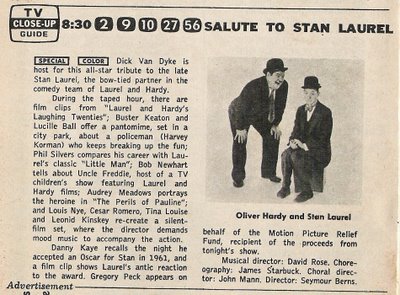
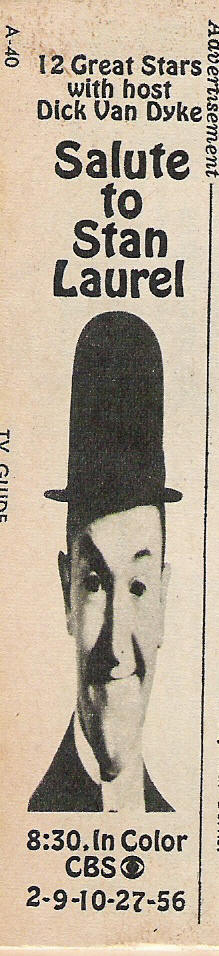
"Salute to Stan Laurel"

Here's how television paid tribute to a comedy giant over 40 years ago:


During TV's Golden Age, it was impossible to miss Laurel & Hardy. Their short films, produced by Hal Roach during the '20's and '30's, were all over the tube. Granted, this was mainly because stations needed product - any product - to fill time; thus the airwaves were literally choked with old movies. But the Laurel & Hardy titles were undoubtedly the classiest in the bunch, and they drew large audiences. Indeed, among the old theatrical two-reelers that comprised early TV programming, only Stan & Ollie, Our Gang (nee "Little Rascals") and Three Stooges shorts continued well into the modern era - and the latter two series had arrived late to the party (1955 and '58, respectively).

This particular Salute wasn't too well received at the time; consequently L&H biographers tend to regard it as well-intentioned, but ultimately inconsequential. Wrapping up the season in April 1966, TV Chronicle's Neil Compton would dismiss the special as "not much of a tribute to the late comedian (who appeared briefly in a number of film clips brutally hacked out of their original context), and did not enhance the reputations of participants such as Dick Van Dyke, Lucille Ball, or Phil Silvers." Indeed, Van Dyke (who was also one of the producers) reportedly complained that his vision for Salute... had itself been hacked to pieces by network corporate types. Not mentioned in the synopsis above is an appearance by Fred Gwynne in full Herman Munster regalia. That clearly had more to do with CBS (home of The Munsters) than with Laurel.

Perhaps this reaction was why we didn't see a network tribute to Buster Keaton, who passed away less than 3 months after this show aired. (Was this his final TV performance? Anyone out there know?) Nor ones for Chaplin, Groucho, or a host of others. For the most part, networks would do better when preparing tributes for their own, such as CBS's look at the life of Lucille Ball in 1989.

Still, any show that features Buster and Lucy doing pantomime together, plus a Bob Newhart monologue, can't be all bad. We'd like to see this one come out of hiding and make it onto an official DVD release. How about it, Dick?

Monday, March 20, 2006

A "Really Big Shewww" in a Really Small Room


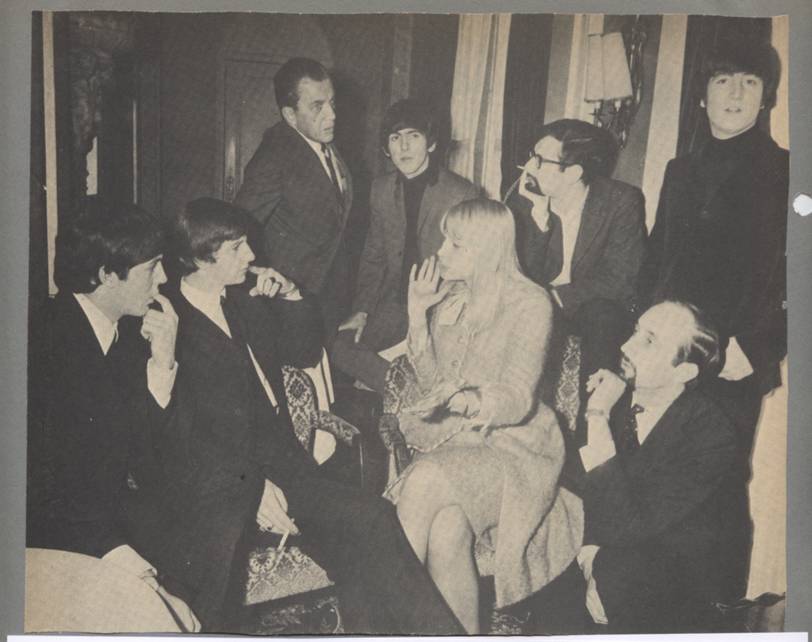
Here's one photo I'd love to know more about. This has the appearance of an unlikely meeting of the minds... perhaps it's an early "Battle of the Bands" with Ed Sullivan serving as referee between The Beatles and Peter, Paul & Mary. As a fan of both folk music and the Fab Four, my curiosity is whetted.

Clearly this is February 1964, either before or after the Sullivan broadcast of February 9; the one that shattered audience records and even led Rev. Billy Graham to break a lifetime's rule and watch the tube on the Sabbath. Perhaps it's Valentine's Day, on which the Beatles would give two concerts at Carnegie Hall. Did P,P&M attend one (or both) of those, sensing it would be at least as momentous as the one the Weavers gave there in 1955?

And what's with the body language? This pic is wallowing in it! Is Paul McCartney trying to give Mary Travers a not-so-subtle suggestion for later on? Mary, meanwhile, is deep in conversation with Ringo... judging by her hands, perhaps she's querying about the percussive use of clapping in "I Want to Hold Your Hand." Peter Yarrow, hand on chin, is focused on Sullivan, as if to even acknowledge the four Liverpool lads would be beneath his dignity. Meanwhile, Noel Paul Stookey seems to be on his knees. Is he worshipping at the Merseybeat altar, or was that the only way to get him into the shot? Maybe he's just envying their hair. As for John Lennon, I like to think that he's asking the photog to take Ed, Peter and Paul and cruise around Central Park for about an hour.

Perhaps the five living participants (six, depending on who the photographer is) might have more valid observations about this event. If so, that's what the comments section is for.

Thursday, March 16, 2006

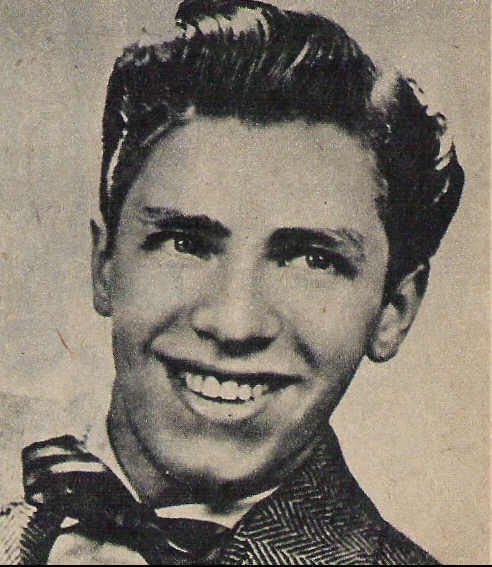
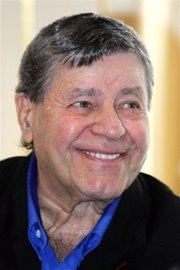
Happy 80th Birthday Jerry Lewis!!!


Then.... and now.

I'll have more to say about Jerry's TV career in weeks to come. But for now, may he have a Happy Birthday, and many, many more!


Photo copyright 2006 by AP Photos

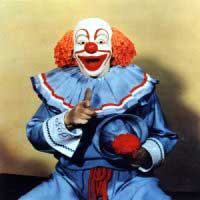
Happy 60th Anniversary, Bozo!!!


When I was a kid in the 1960's, Bozo the Clown was a must-see program. I didn't find out until much later that practically every major city in the U.S. had its own "Bozo," or that the clown didn't actually get his start on television, but on records.

In 1946, Alan Livingston of Capitol Records conceived of the clown as a narrator of a children's record. The disc ended up a major seller, which naturally led to equally successful sequels. By 1949, Livingston got the idea of making Bozo a TV personality. Pinto Colvig (right), best known as the original voice of Disney's Goofy and who voiced the clown on Capitol's records, became the first to actually portray Bozo, over KTTV-11 in Los Angeles. This venture, too, proved to be an enormous success, and Livingston wound up hiring various "Bozos" specifically for personal appearances. One of these was Larry Harmon, who eventually pooled his resources, bought the rights to the character from Capitol, and turned Bozo into a marketing juggernaut.

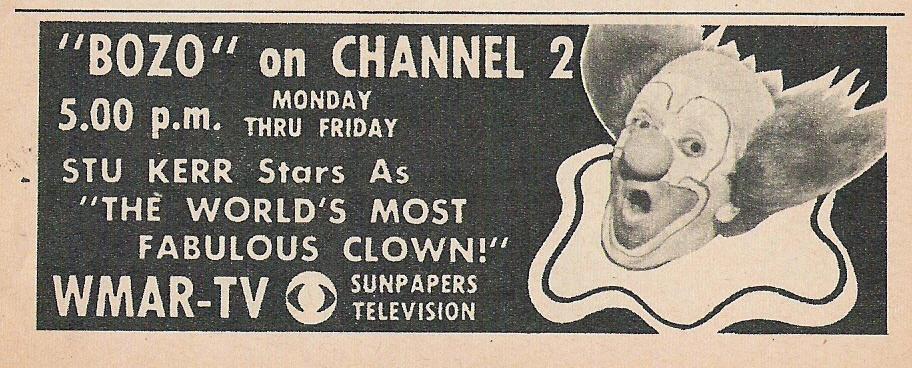
It was Harmon's idea to create Bozo programs unique to each major city. In Chicago, home of the longest-lasting Bozo program, the clown was portrayed by Bob Bell, then Joey D'Auria. Stu Kerr took the part in Baltimore (left), and Frank Avaruch in Boston.

If the Bozo on the right reminds you of a certain famous Today Show weatherman, it's no coincidence: for a time, Willard Scott was Washington D.C.'s clown.

Anybody out there ever own this punching bag clown? I did - and it's still available!

After 60 years, Bozo remains a viable commodity, despite his absence from daily or weekly television. In 2003, Bozo returned to his audio roots with a CD release entitled "Get Down with the Clown." For more on Bozo's history, as well as the merchandise seen here, visit Clown-Ministry.com at http://www.clown-ministry.com/History/bozo-clown.html.

Oh, yes: for the story behind a certain encounter between Bozo and a rather rude child - one that may or may not be apocryphal - go here: http://www.snopes.com/radiotv/tv/bozo.htm